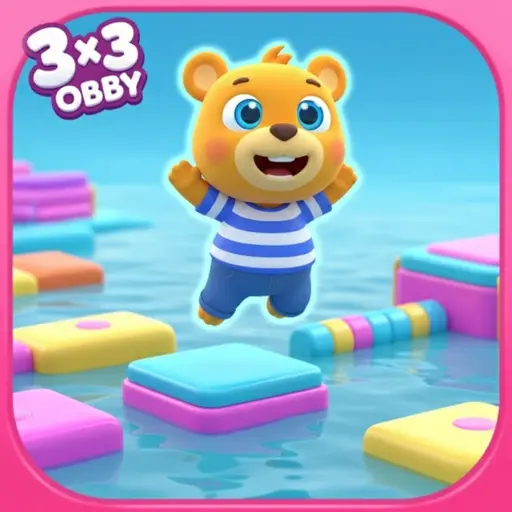
3×3 Obby is a browser-based obstacle course game that asks you to do one thing well: get from the beginning of the course to the finish without falling. You move your character across platforms, jump over gaps, line up landings, and work your way through increasingly challenging sections. The controls are easy enough for a new player to understand almost immediately, but the actual challenge comes from using those controls accurately.
That distinction is important.A lot of people see an obby and assume it’s mainly a test of reflexes. I don’t think that’s quite right. Reflexes help, obviously, but after spending some time with 3×3 Obby, I found that awareness and control are much more important. The game doesn’t usually beat you because you weren’t fast enough. It beats you because you made a small movement at the wrong moment.
That makes it more interesting than it first appears.When I started playing, I approached the course with the usual mindset: move forward, jump when necessary, and keep going. It worked reasonably well until the obstacles became less forgiving. Then I noticed something I should have realized earlier – I wasn’t really controlling my character; I was reacting to the course.There’s a difference.If you wait until you’re already standing at the edge of a platform to decide where you’re going next, you’re giving yourself less time to make a good decision. If you look ahead and understand the next few movements before you get there, the course becomes much easier to read.
 That’s the first piece of advice I’d give a beginner.
Look ahead.You don’t need to memorize the entire level, and you certainly don’t need to treat the game like an exam. Just pay attention to what’s coming. If the next platform is positioned slightly to one side, start adjusting before you reach the edge. If there is a series of small platforms ahead, think about the sequence instead of treating every jump as an isolated challenge.That small change in thinking makes a surprisingly big difference.
I also recommend that new players resist the temptation to move as quickly as possible. Speed looks impressive, but consistency is more valuable when you’re still learning. If you can complete five jumps slowly and accurately, you’ll eventually be able to complete them faster. If you’re constantly rushing and falling, you’re mostly practicing falling.I’ve done plenty of that myself.
One of the more interesting aspects of 3×3 Obby is how much the experience changes once you’ve learned the layout. During the first attempt, you’re dealing with uncertainty. You don’t know exactly what is coming, so you have to react. On later attempts, that uncertainty disappears, and you can start focusing on execution.That’s where I think the game gets more satisfying.You begin noticing the little things.
Maybe you were approaching one platform from the wrong angle. Maybe you were making an unnecessary correction in midair. Maybe you were stopping before every jump even though the movement could be smoother. These aren’t dramatic mistakes, but cleaning them up can completely change how the course feels.
For experienced obby players, that’s probably where most of the replay value comes from.
You’re no longer asking, “Can I finish?”
You’re asking, “How cleanly can I finish?”
Those are two very different challenges.
A beginner might be happy after finally clearing a difficult section. An experienced player might immediately replay it because they know they could have landed more efficiently. Personally, I enjoy that second stage because it turns the course into something you can practice rather than simply complete once.It’s almost like learning a short piece of music. At first, you’re just trying to get through it without making mistakes. Later, you’re trying to make the whole thing flow naturally.The same principle applies here.
You want the movement to feel deliberate without feeling stiff.That balance can take practice.Another important lesson is learning when to stop correcting yourself. New players sometimes make a jump and then panic because their character isn’t perfectly centered over the platform. They start making several small movements in a row, and those corrections actually make the landing worse.
I’ve thrown away plenty of otherwise good jumps that way.
Sometimes you have already made the jump.
You just need to let the character land.
It sounds silly, but learning when not to move is part of good platforming.
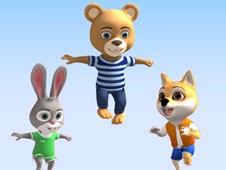 The visual presentation supports this style of gameplay because the course itself remains the focus. You don’t need a complicated interface distracting you while you’re trying to judge a jump. The important information is right in front of you, which makes it easier to concentrate on movement and positioning.For me, that’s exactly how an obstacle game should work.
I also think 3×3 Obby has a useful balance between accessibility and challenge. Someone who has never played an obby can understand the objective almost immediately, while experienced players can create their own goals. You can aim for completion, consistency, fewer mistakes, or faster movement.
That flexibility matters because not every player approaches obstacle games in the same way.
Some people just want to finish the course.
Others want to master it.
Both approaches are valid.
If you’re new, I’d suggest taking the first few attempts as practice runs. Don’t worry about how many times you fall. Instead, learn the movement and figure out which sections require the most attention. Once you’ve seen the course a few times, you’ll naturally become more confident.
If you’ve already played a lot of obby games, I’d recommend focusing on efficiency. Try to reduce unnecessary stops. Learn the best position for each jump. Pay attention to how much you adjust your movement in the air. Once the basic route is familiar, these small details become the actual challenge.
And that’s where I think the game has more depth than its simple presentation suggests.
It doesn’t need a complicated skill tree to give you something to improve.
Your own movement is the skill tree.
Every failed jump tells you something.
Every successful run gives you a reference point.
Every replay gives you a chance to clean up another mistake.
That said, I would like to see more content added over time. Obby games naturally have a problem with memorization. Once you’ve learned every obstacle, the surprise factor disappears. New stages, alternate routes, tougher obstacle combinations, or special challenges could make the experience much more interesting for regular players.
Still, I don’t think 3×3 Obby needs to become overloaded with features.
The core idea is strong enough.
You have a course.
You have your movement.
You have your own ability.
That’s it.
And sometimes that simplicity is exactly what makes a game enjoyable.
After playing 3×3 Obby, I came away with a slightly different appreciation for obstacle games. I expected a basic jumping challenge, but I ended up paying much more attention to positioning, timing, and consistency than I expected.
The game isn’t really asking you to be the fastest player in the world.
It’s asking whether you can control yourself well enough to make the jump.
For a beginner, that means learning patience.
For an experienced player, it means learning precision.
And for me, it means occasionally reminding myself that the fastest way through an obstacle course is usually not to panic and throw my character into the nearest wall.
That’s a lesson I apparently need to keep learning.